KurchuSoftware Solutions
 By
What can an AI app builder do well?
AI app builders, sometimes called vibe-coding tools, turn a plain-language description into a working app. For a founder, that changes the first week of a project: instead of describing an idea in a document, you can click through it, show it to customers and see which parts they ignore.
They are strongest where mistakes are cheap: a clickable prototype for investor or customer conversations, an internal tool used by a handful of colleagues, or a simple web form or dashboard that does not handle sensitive data.
Where do AI-built apps usually fall short?
The gap shows up in the work users never see. A generated app can look finished while the parts that protect users and the business are thin or missing.
- Security and privacy: access rules, data encryption and data retention that satisfy UK GDPR, CCPA or the UAE PDPL.
- Payments: refunds, failed payments, receipts and reconciliation, plus Apple and Google's rules for in-app purchases.
- Mobile release: code signing, testing on real devices, store listings, privacy declarations and App Store review.
- Change over time: a structure a developer can extend next year without rewriting it.
- Ownership: being able to move the code and data away from the tool that generated them.
AI app builder vs development team: how do they compare?
The two are not really competitors. They are good at different stages of the same product:
| AI app builder | Development team | |
|---|---|---|
| Time to a first working version | Minutes to days | Weeks — typically 5–13 weeks for a first release with Kurchu |
| Cost to start | Free or a monthly plan | A fixed price per phase |
| Product and design judgement | Yours alone | Senior product, design and engineering input |
| Payments and personal data | Needs an expert review | Designed in from the first sprint |
| App Store and Google Play release | Mostly left to you | Handled, including review notes and rollouts |
| Maintenance after launch | You maintain what was generated | Monitoring, OS updates and fixes on a plan |
| Best for | Prototypes, demos, internal tools | Apps customers pay for or trust with data |
When is an AI app builder enough?
- You want to test whether customers care before spending on a build.
- The app is for internal use, by a small team, with no sensitive data.
- It is a web tool or dashboard that never needs to be in the app stores.
- You need something to show investors or partners this month.
When do you need a development team?
- The app takes payments, subscriptions or deposits.
- It stores personal, financial, health or children's data.
- It must be on the App Store and Google Play, not only on the web.
- It needs live tracking, offline mode, chat or integrations with your existing systems.
- Customers will rely on it, so outages and bugs cost you money or reputation.
How do you turn an AI prototype into a store-ready app?
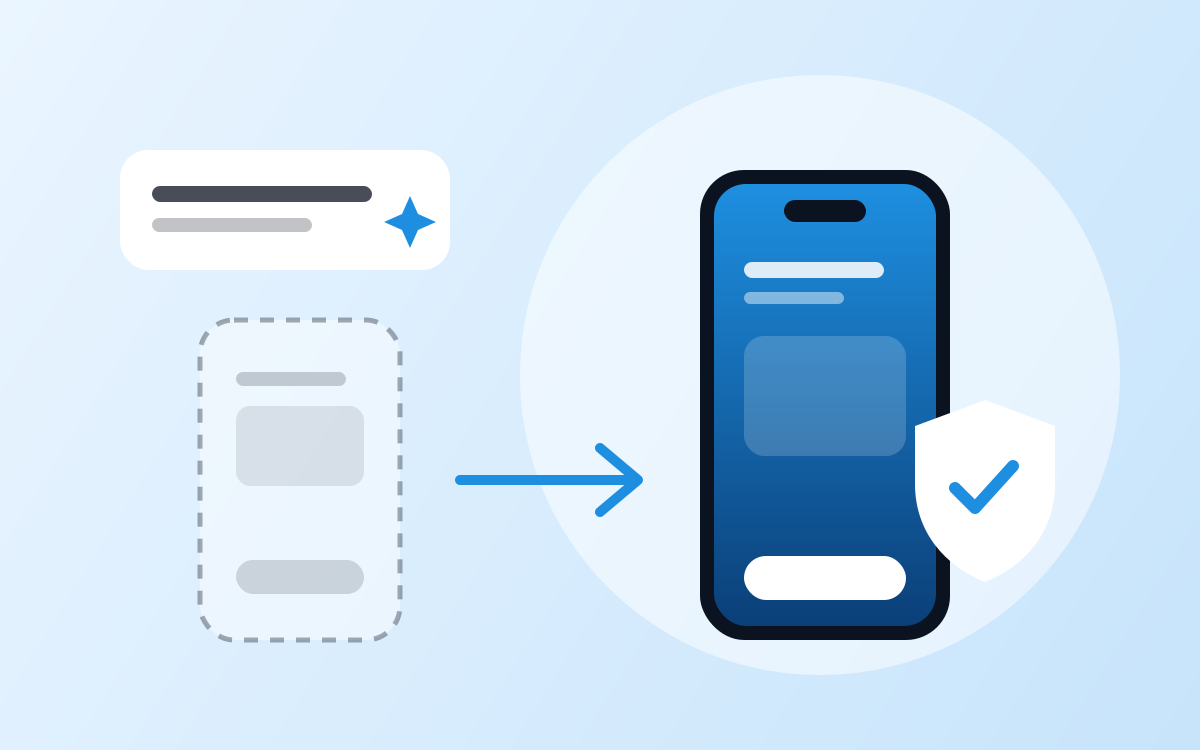
Treat the prototype as a brief, not a codebase you are obliged to keep. A good team reviews what was generated, keeps what is sound, and rebuilds the parts that carry risk — usually authentication, data storage and payments. The prototype's real value is that the screens and flows are already agreed, which shortens discovery and design.
With Kurchu, that work is priced from the same published feature table as any other project. For example, a salon booking app's first release is estimated at $940–$2,450, and a food delivery app's at $1,650–$4,150. You keep full ownership of the code, and the app ships to both stores with testing and monitoring in place.